25.11.26
|Reading time:
4 min
AI in Swiss foodservice: where it helps and what remains the team's responsibility
Artificial intelligence plans menus, writes recipes and analyses data. For the around 32'000 businesses in Switzerland's foodservice industry, the question is therefore less whether AI is coming and more where it belongs. The Gottlieb Duttweiler Institute (GDI) in Rüschlikon gives a clear answer in its whitepaper «AI on the Menu» (2026): AI helps where something can be measured and planned. What guests experience as hospitality remains the responsibility of people.
In this article, Vendomat AG puts the findings into context for Swiss foodservice businesses.
What did the GDI study on AI and food culture?
The GDI, Switzerland's oldest think tank, draws on its study «Decoding Food Culture» (2024) for its whitepaper «AI on the Menu». The study surveyed 2'100 people from Switzerland and from border regions of Germany, France, Italy and Austria. It identified six dimensions of food culture: Enjoyment, Community, Health, Control, Rituals and Roots.
These six dimensions respond very differently to AI:
- Strengthened are Control and Health, because they can be measured and optimised.
- Ambivalent are Enjoyment and Rituals: AI can inspire and ease routines, but it replaces neither the sensory experience of taste nor the significance of a ritual.
- At risk are Community and Roots, that is, eating together and the traditional knowledge about origin and preparation.
These differences can be summed up in the image of the plate and the table. The plate represents everything that can be measured, personalised and controlled, such as portions or nutrients. The table represents the social, symbolic and cultural side of eating. AI can optimise the plate, but when it comes to the table, it reaches its limits.
How does AI help with allergens in Swiss restaurants?
For the foodservice industry, AI is mainly useful behind the scenes in tasks such as menu planning, reducing food waste, communicating allergens and planning staff deployment.
Allergens are a good example in Switzerland because the rules are clear. According to the Federal Food Safety and Veterinary Office (FSVO), allergens must in principle be stated in writing for foods sold unpackaged, expressly including dishes served in a restaurant. A business may dispense with written information if a written notice shows that the information is given orally. In this case, the information must be available to staff in writing or be able to be conveyed by a qualified person. For individual questions, the cantonal food inspection authority can help.
Digital systems can help record allergens. In the Lightspeed POS system, allergens can be stored. Vend.AI self-order terminals from Vendomat AG show guests the allergens directly when they place their order.
Where should the team's time be spent?
GastroSuisse, the association for the hotel and restaurant industry, counts 270'000 employees in the Swiss foodservice sector. The association describes the shortage of qualified staff as a challenge.
When systems take over routine tasks, staff gain room for the irreplaceable core of the foodservice experience: welcoming guests, conversations with the service staff and knowing where a product comes from. Businesses that use AI in this way combine the best of both worlds.
One example is the Lightspeed AI Agent: in the back office of the Lightspeed POS system, it answers questions about sales data, for example about the best-selling and weakest-selling items of the previous week. Find out more in the Vendomat article New AI tools in the Lightspeed POS system. There are also such aids in administration: the PINIT digital office assistant helps to capture and assign supporting documents such as invoices and receipts digitally. It replaces neither the team nor the fiduciary, as the article PINIT: Your digital office assistant for foodservice explains.
What no software can replace: fondue at the table
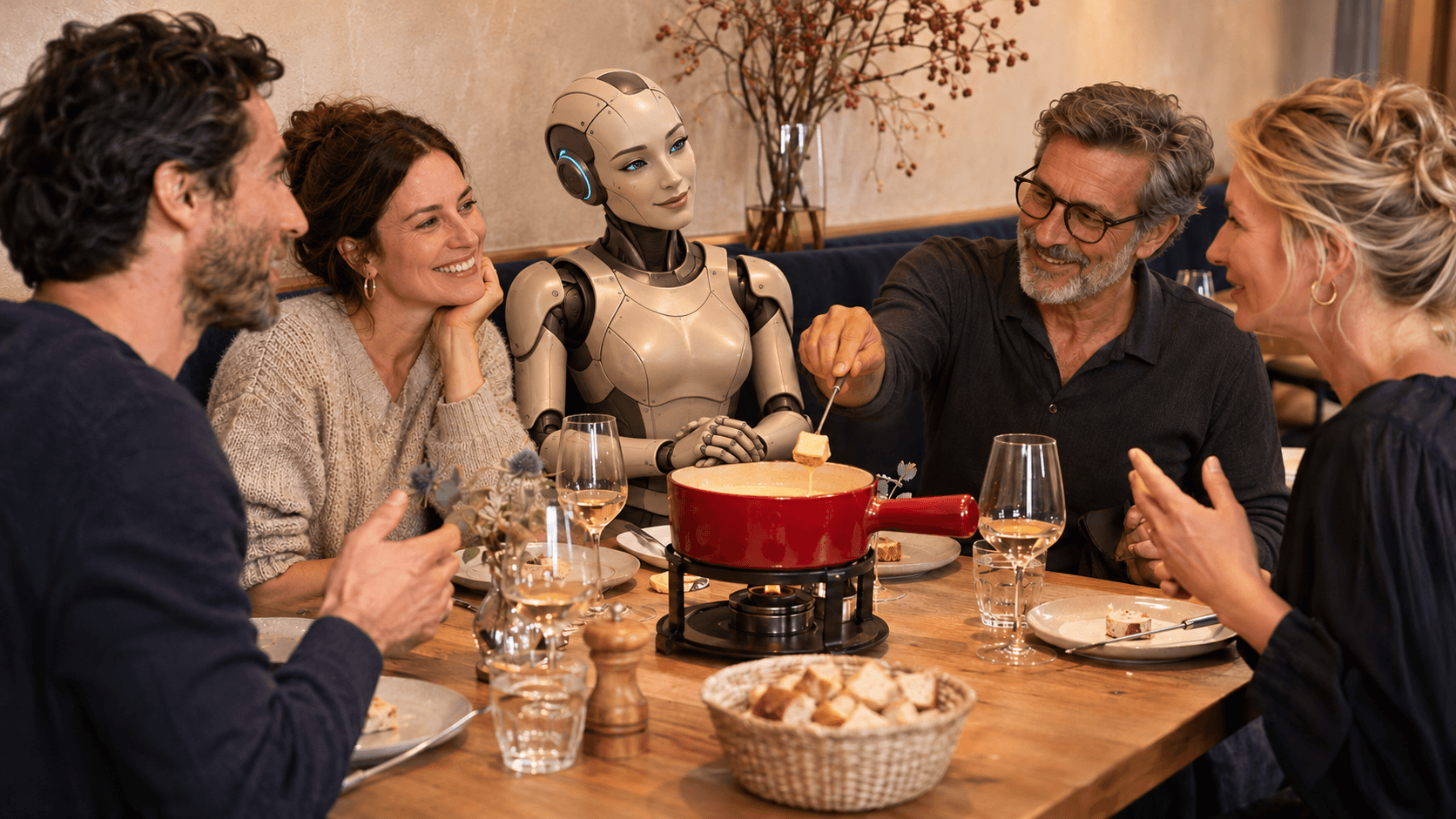
In the GDI survey, community is the most important of the six dimensions of food culture, in all countries surveyed. For 75 percent of respondents, eating is a social event. Fondue illustrates this: AI can coordinate reservations and recommend restaurants, but it cannot create the moment when everyone at the table dips their fork into the fondue for the first time at the same time.
The whitepaper also draws on the so-called "word-of-machine" effect: when it comes to questions of efficiency or health, people are more inclined to trust AI. When it comes to enjoyment and personal taste, they prefer to trust a human. AI will not replace the wine sommelier for the time being. Recommendations on wine and enjoyment therefore remain tasks for the team.
The study also describes a process of homogenisation: algorithms filter what we see, and offers adapt to this visibility. Examples include viral recipes, restaurant reviews and menu boards created with AI.
For Swiss foodservice businesses, this development is an opportunity: Telling the story of producers, ingredients and preparation is a valuable point of differentiation from highly homogenised concepts. It is possible that "Human-Made", meaning visibly made by people, will become a new premium category, much like organic. A generally recognised label for this does not yet exist.
| Plate: systems can support | Table: stays with the team |
|---|---|
| Menu planning and purchasing | Welcoming and greeting guests |
| Recording allergens | Wine recommendations and enjoyment |
| Planning staff deployment | Stories about origin, ingredients and preparation |
| Evaluating food waste | Sharing a meal as an experience |
The GDI therefore does not recommend choosing between the plate or the table in its whitepaper. The guiding question is: when do you serve from the plate, and when from the table?
Vendomat AG's perspective
From the perspective of Vendomat AG, AI belongs in Swiss foodservice where it takes over routine tasks in the background and makes the working day noticeably easier. What matters is the concrete benefit for the business: fewer manual steps, information available faster and more time for guests.
Which tasks are suitable depends on the workflows in each business. AI can prepare information and make suggestions. The team checks the results, contributes its experience and decides what is implemented. This keeps control with people, just as the personal touch that defines a business does.
Raoul Corciulo
CEO
Sales & Customer Success
Capture in-house know-how before it is lost
The GDI whitepaper warns that traditional cooking knowledge can be lost: when is a dough kneaded enough? How long must a sauce reduce? AI can only process what has been recorded. What is not documented anywhere remains invisible to systems.
For Swiss foodservice businesses, this means that anyone who records recipes, quantities, allergens and work steps in writing safeguards the knowledge of the house. Written in-house know-how helps when onboarding new staff and forms the basis when details are later used in the till, on the menu or in planning.
Now
book a free consultation
How Vendomat supports Swiss businesses
Vendomat AG is a digitalisation partner for the foodservice and hotel industries in Switzerland. With more than 35 years of experience, the company connects Lightspeed POS systems, payment solutions and self-order terminal solutions with digital applications for ordering, reporting and accounting. Data is passed on automatically, manual steps are reduced and workflows are made simpler.
As a Lightspeed Diamond Partner headquartered in Schönbühl, Vendomat supports over 2'700 tills in Swiss businesses. From the first consultation through training and installation, Vendomat personally accompanies the introduction. Afterwards, the team remains available for support and further developments, so that the systems grow along with the needs of the business.
Less routine work, more time for your guests: find out with Vendomat where digital systems can relieve your business.