05.05.26
|Reading time:
4 min
New AI tools in the Lightspeed POS system
Lightspeed is expanding the POS system for the hospitality industry with new features based on artificial intelligence (AI). With Lightspeed AI, restaurants, bars, and cafés can analyze sales data more easily, identify developments faster, and ask questions about business data directly in the back office.
This makes AI in the POS system more practically usable for hospitality businesses: not as a separate tool, but directly where sales figures, product groups, order times, and menu performance already come together.
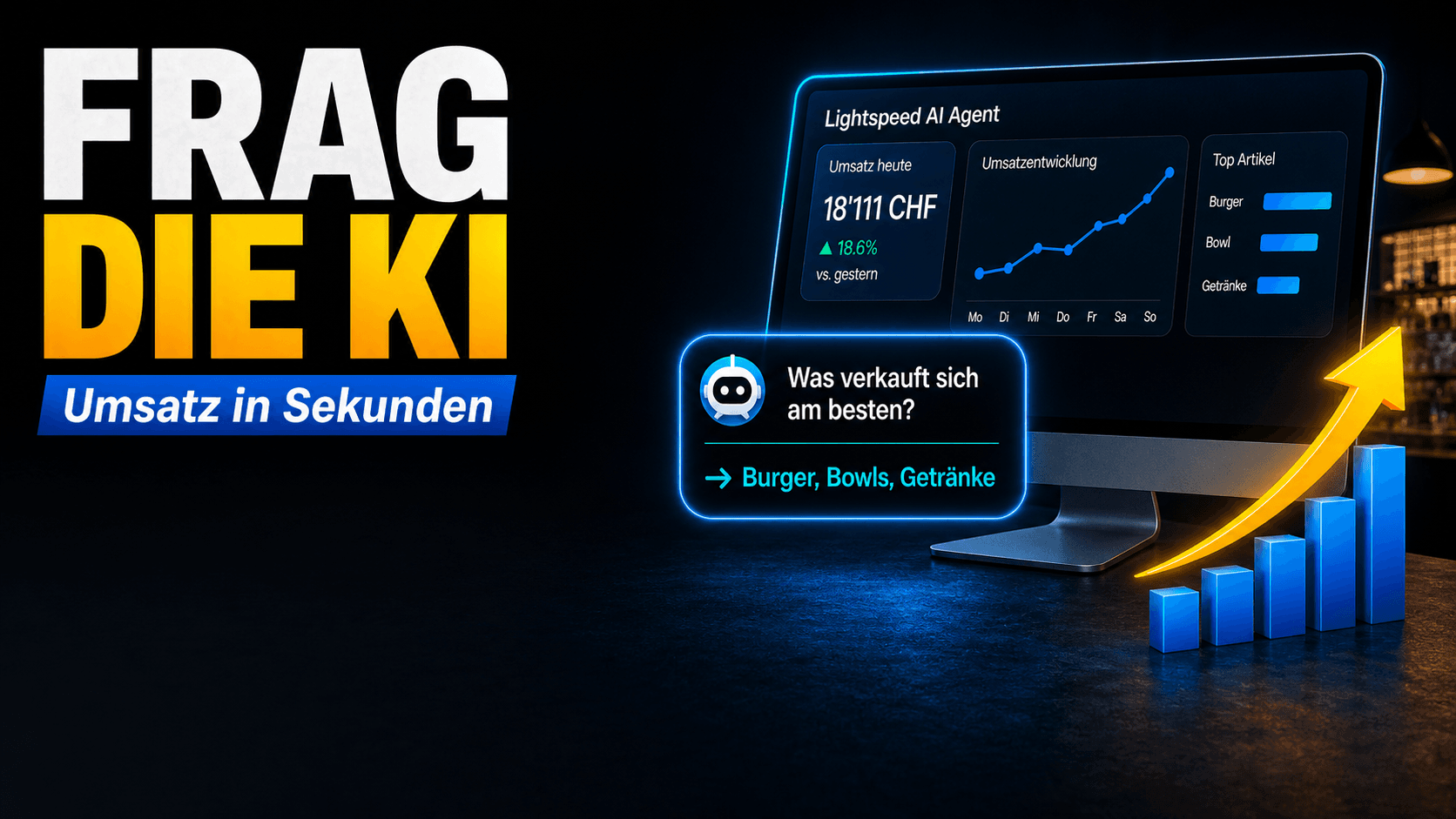
At the center is the Lightspeed AI Agent. It helps make available Lightspeed reports easier to understand and retrieve information faster, without having to search through traditional reports one by one.
Key points at a glance
- Lightspeed AI brings new AI tools into the Lightspeed POS system.
- The Lightspeed AI Agent is available in the back office.
- Hospitality businesses can ask questions about sales data and business data.
The features support menu performance, planning, and reporting.
What is Lightspeed AI?
Lightspeed AI is an integrated extension for Lightspeed Restaurant. It supports hospitality businesses in better understanding and interpreting existing sales and business data more quickly.
The focus includes:
- Sales figures
- Menu performance
- Service trends
- Product groups
- Shifts
- Orders
This means the POS system is not only used to record data, but also to better interpret this data during day-to-day operations.
How does the Lightspeed AI agent work?
With the Lightspeed AI Agent, users can ask questions about their business data. The answers are based on the available information from Lightspeed reports and are presented in an easy-to-understand format.
This is especially helpful when a quick overview is needed, without having to manually open and compare individual reports.
Example from the application
In the following video, you can see an example of how the Lightspeed AI Agent answers a question about the development of the kitchen group and presents the analysis graphically.
Possible everyday questions
Typical questions or prompts could include:
- Compare the development of the kitchen group over the last 3 months and also display it graphically.
- Which items in the dessert group were sold the least in the last 30 days?
- Compare lunch service and dinner service over the last 4 weeks.
- Which weekdays had the highest revenue in the last 8 weeks?
The benefit lies in being able to query data more specifically and display it in a more understandable way.
What are the benefits of AI tools in the POS system?
For hospitality businesses, the goal is not to add more complexity to operations. The value lies in making existing data easier to use.

1. Faster overview of sales data
Lightspeed AI can summarize sales data in an understandable way and make developments visible. This makes it easier to identify trends faster, without having to build every analysis manually.

2. Better understanding of menu performance
Especially for restaurants and cafés, it is important to know which dishes or products perform well and which are less in demand. Lightspeed AI can help identify best sellers and weaker items.

3. Support for planning and ordering
Lightspeed also describes the possibility of using revenue data, weather data, and event data for better decisions around staff planning and orders. For businesses with fluctuating footfall, this can provide valuable guidance.

4. Less effort for reporting
Traditional reporting tools provide many figures. The challenge is often to interpret these figures quickly. Lightspeed AI is designed to simplify this process by translating data into more understandable insights.
Which hospitality businesses is Lightspeed AI relevant for?
Restaurants
Restaurants can use Lightspeed AI to better understand sales developments, menu performance, and demand. This is particularly interesting for businesses that regularly review their menu or adapt it seasonally.
Bars
Bars benefit above all from insights into sales times, shifts, and product trends. This can help identify high-demand products more clearly and approach planning in a more targeted way.
Cafés
For cafés, daily patterns, recurring orders, and product performance are especially relevant. Lightspeed AI can help make this data easier to view.
Businesses with multiple locations
Structured reporting can also be helpful for hospitality businesses with multiple locations. Developments can be compared more effectively when data is available consistently in one system.
Why is this relevant for hospitality businesses in Switzerland?
In the Swiss hospitality industry, overview, efficiency, and fast responsiveness are important. Restaurants, bars, and cafés need to keep track of their offering, service, staff planning, and purchasing on an ongoing basis.
A POS system that not only records data but also makes it easier to analyze can make a practical contribution here. Especially when decisions should also be supported by concrete figures.
Using Lightspeed AI with Vendomat
Businesses that want to use Lightspeed in the hospitality industry benefit from a clean implementation and a solution that fits their own operation.
Vendomat supports hospitality businesses in Switzerland in using Lightspeed Restaurant and helps align the POS system, workflows, and operational requirements in a meaningful way. This turns new technology into a solution that is practically usable in everyday operations.
Raoul Corciulo
CEO
Sales & Customer Success