22.04.26
|Reading time:
4 min
5 myths about self-order terminals in hospitality
There are different experiences and assessments when it comes to self-order terminals. That is hardly surprising, because every business has different processes, different guests, and different requirements. Especially for restaurants, bars, and cafés in the German-speaking and Italian-speaking parts of Switzerland, it is worth looking at the specific situation in your own business.
That is why we are taking a closer look at the five common myths surrounding self-order. Because it is often only in day-to-day operations that what really matters becomes clear.
Myth 1: 🍔 Order terminals are only suitable for fast food
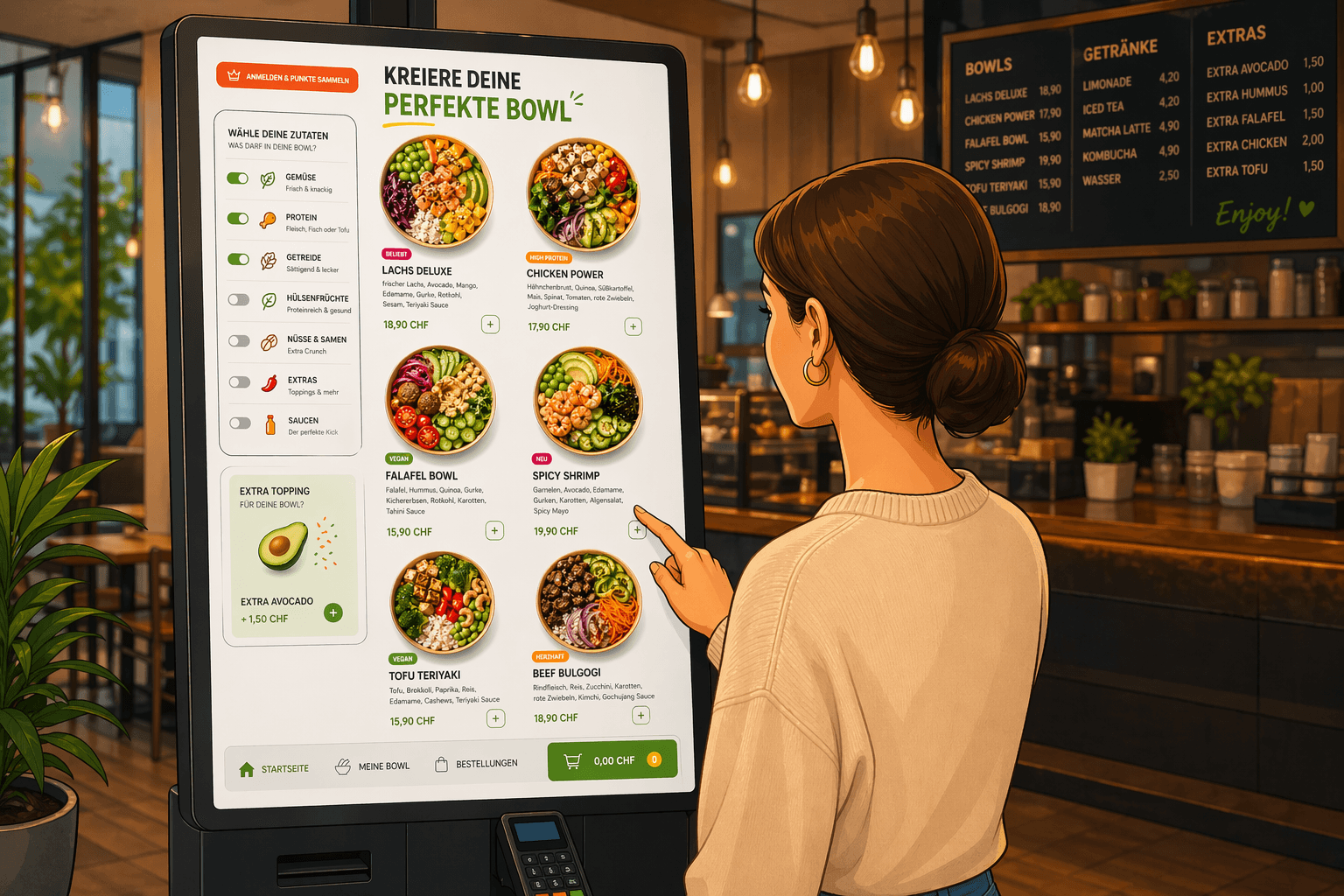
This impression persists, but in day-to-day operations it is often not true. What matters is not whether a business sells burgers, pasta, aperitifs, coffee, or lunch menus. What matters is how orders arise in the business. Wherever many guests order in a short period of time, products are clearly structured, or takeaway runs alongside on-site business, self-order can work very well.
This also makes one thing clear: order terminals are not limited to a specific type of business. They can make sense in restaurants, bars, and cafés if they match the menu structure and the guest flow.
What matters in practice
- High volume instead of a specific type of business
- Clear menus, variants, and add-ons
- Relief during lunch business and takeaway
- More structure in the ordering process
- Better handling during peak times
Myth 2: 🤖 Self-order makes service impersonal
Many businesses place great value on hospitality and direct contact. That is exactly why this point is sensitive. In day-to-day operations, however, it often becomes clear that self-order does not replace good service, but rather takes over standardized steps in the ordering process. This gives the team more time for greeting guests, advising them, handing over orders, and being present in the space.
So personal service does not disappear. It shifts to where it is truly important for guests. Especially in businesses with a high pace, this can be a clear advantage.
What matters in practice
- Less pressure during order taking
- More time for real guest contact
- Clearer roles within the team
- Calmer processes at heavily frequented points
- Service remains important, just used more purposefully
Myth 3: ❌ Guests don't want a digital ordering option
Many guests don't want less service, but more freedom of choice. Some like ordering directly from the team, while others want to set their own pace, browse calmly, or adjust their order without time pressure. This is exactly where self-order shows what it can do.
This is especially relevant in Switzerland. Multilingual menus, clear product descriptions, and easy-to-understand ordering steps make the process easier for different guest groups. This helps not only with tourist audiences, but also in normal day-to-day business.
What matters in practice
- Guests can choose the ordering option that suits them
- Multilingual support makes use easier
- Allergens, ingredients, and adjustments are easier to see
- Fewer misunderstandings when ordering
- A calmer ordering experience during busy periods
Myth 4: 💰 No real selling happens at the terminal
This point is also often underestimated. A well-structured self-order terminal does not sell less, it sells in a more structured way. Menus, sides, drinks, extras, or upsellings can be placed exactly where they make sense for guests. This often feels more natural because the guest decides calmly and is not under time pressure.
What matters here is not showing as many suggestions as possible. What matters is a clean menu logic. If the offer is clearly structured, additional sales can be supported in a meaningful way without feeling pushy.
What matters in practice
- Additional products become visible at the right moment
- Menus and upsellings can be structured logically
- Special requests are captured cleanly
- The ordering process remains clear and easy to follow
- Structure can have a positive effect on average spend
Myth 5: ⚙️ Implementation is complicated and only worthwhile with a major effort
Self-order does not have to be seen as a complete rebuild. In many businesses, it makes more sense to start with a clearly defined use case, for example during lunch business, for takeaway, or at a heavily frequented counter. This allows the solution to be integrated into day-to-day operations step by step.
What matters above all is that self-order is not viewed in isolation. It delivers the most value when menu structure, payment process, team workflow, and digital cash register work together cleanly. The order terminal is therefore not a competitor to the cash register, but a meaningful addition to the overall process.
What matters in practice
- Start with a clear use case
- Set up products and variants cleanly
- Think about the process from the guest perspective
- Involve the team early
- Connect self-order and the digital cash register cleanly
- Introduce it step by step instead of doing everything at once
⬇️ How a SOT works so simply ⬇️
Conclusion: Self-order works best when it fits the business
Many myths surrounding self-order terminals sound plausible at first. But in day-to-day operations, a different picture often emerges as soon as you look at the specific business. Not every hospitality business works in the same way, not every guest flow is identical, and not every offer needs to be mapped digitally in the same way. That is exactly why what matters is not general statements, but a clear assessment.
Where orders recur regularly, guests want to decide quickly, and processes need to be eased at specific points, self-order can make a real difference. It creates structure, brings more calm during peak times, and complements personal service where digital ordering provides real operational relief.
Anyone who wants to think about self-order and the digital cash register together in a meaningful way should look for solutions that reflect exactly this interaction for Swiss hospitality businesses. This is exactly where Vendomat becomes interesting, for example with self-order solutions and modern cash register integration such as Lightspeed, without the business losing its personality.